
Frequently Asked Questions
Have a question about M&R Printing Equipment, Inc. or about M&R printing machines like manual & automatic screen/textile presses, hybrid printers, direct to garment (DTG) printers, direct to film (DTF) printers, graphics presses, conveyor dryers, computer-to-screen (CTS) imaging & exposure units, or other products? Check out the FAQs shown below.
Customer Service
2. Innovation: We’re on the cutting edge, with products like the first successful two-tier (Duo-Deck) manual press (Chameleon), the patented dual-reflector UV cure system (Vitran, Switchback, Processor, & Advantage), and the first successful auto-unloader for textiles (Passport).
3. Service & Support: With all of our resources, our network of distributors, our after-sale technical support, 24/7 service hotline, parts warehouses, and the wide range of products available from M&R and our sister companies, Amscomatic & NuArc, M&R simply offers more for your dollar in the long run. No matter where you are or where you want to go, M&R has the products to get you there.
Exposure Systems
All NuArc exposure systems rely on vacuum drawdown to ensure the closest film-to-screen contact and the sharpest images.
Automatic centering lamps are found exclusively on larger models of NuArc’s Helios large-format exposure system. The operator simply punches in the correct screen size and the Helios will center the lamps. The result is a fast, even exposure.
NuArc’s First Light and Mega-Light UV Fluorescent Exposure Systems use multiple light sources. Both units are versatile and affordable, and represent ideal solutions for startup manual screen shops. All the other exposure systems in NuArc’s lineup, from the MSP 2125 through Helios and Helios T, employ a point light source.
NuArc offers both types: the instant-start Tri-Light and the shuttered Tri-Light ST and Tri-Light CTS.
Although Quartz Halogen lamps have been used for screen making, they produce a very poor light source. The quartz halogen lamp is basically a high-wattage incandescent lamp that emits a lot of white light but very little of the UV that emulsions require. It’s ironic, but some people invest in what they think is a high-quality exposure system and then compromise performance by using the wrong light source.
Metal Halide is the best light source for today’s emulsions, but be aware that not all metal halide lamps are the same. Those designed to light a warehouse or parking lot have additives that give off more visible light. The light source that provides the best results and fastest screen exposures peaks out in the 350-450 nm range.
Graphic Screen Printing
M&R's Switchback and Vitran II UV Cure Systems use dual-reflector technology. See the PDF brochures for a graphic depiction of dual-reflector technology.
Available on many M&R graphic presses, Job Recall speeds job setup and changeover. Once an operator has fine tuned settings for a particular job, he/she can assign a name to those settings and then store them in the memory of the press. The next time a similar job is run on the press, the operator can simply call up that job name to have the appropriate settings automatically applied to the press. If a new job is similar to a stored job, but different in one or more aspects, the operator can modify some settings and store the new job settings under another name.
Job Recall dramatically speeds job setup and print consistency.
Online Store
HTTP cookies (also referred to as tracking cookies, or cookies) are small pieces of text stored by a your web browser that contain useful information related to your use of the mrprint.com website.
We use cookies to store information about your account user name, so you don't need to type it in the next time you visit the site.
Cookies are also used to store your selections when you use a temporary shopping cart in our store.
To protect your data, the site uses secure https communication mode.
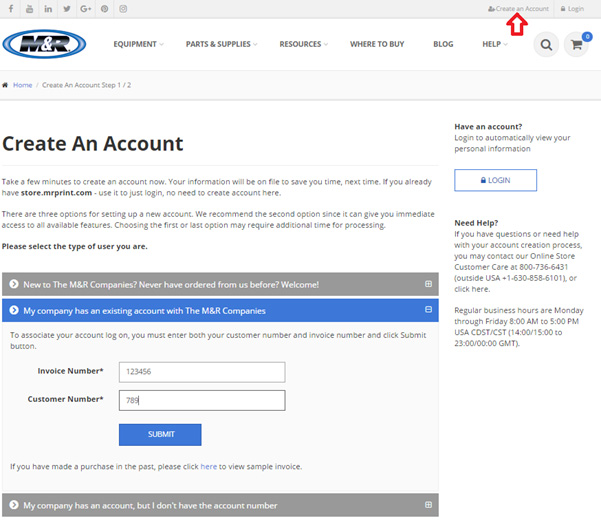
If you do not have an account, go to store.mrprint.com or www.mrprint.com, click "Create an Account" at the top of the page, and follow the onscreen instructions.
After you receive a confirmation email you'll be able to view invoices and other order information.
If you have problems during or after registration, click "Contact Us" under "Help" and enter your message. Please do not contact M&R’s Credit Department for web-related issues.
- Each machine's equipment serial number is located within the Equipment Identification Plate.
- The Equipment Identification Plate contains information particular to your model of the machine and it helps us to uniquely identify your model and the appropriate parts for that machine.
- The serial number is located on the bottom-right corner of the Equipment Identification Plate.
- The Equipment Identification Plate placement differs for various product lines.
- It's a good idea to know where to find the Equipment Identification Plate on your equipment since it will the first information we will ask you for when ordering parts or providing service and support. You may want to keep all of your equipment serial numbers in an easy to access location just for this purpose.
After you've logged in, click "My Account". From the pulldown menu, select "Orders".
To locate a specific order, search by order, invoice, PO number or other criteria. You can also ask to see recently placed orders. See the screen shot below.
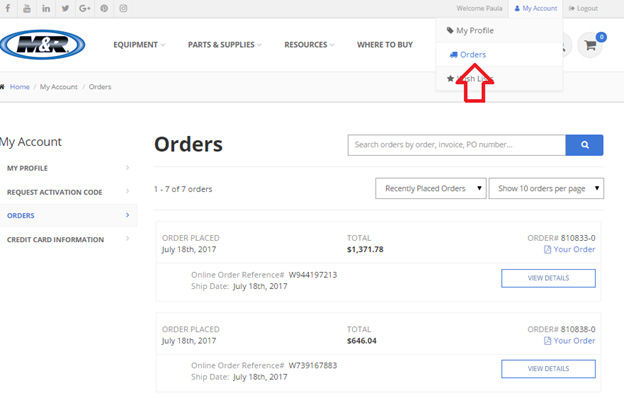
At the bottom of the page (not shown) there is a section on how to retrieve backup information for service invoices.
Instead of searching for invoices on your "Orders" page, you can select "My company has an existing account with M&R Printing Equipment, Inc." from the "Create an Account" page. Then enter the invoice number and your customer number. Then click SUBMIT.
Search by
- M&R Item number
- Any word within item description
- Any word within item detail page
- M&R Serial Number
- M&R Equipment Number
- Manufacturer's item number (if applicable)
Search examples
- "1" will return all items starting with number 1
- "1002039" will return the part with item number 1002039. This is the fastest way to search our catalog.
- "WiRE" or "WIRES" returns all items having a word starting with "WIRE" or "WIRES" in its description
- "WIRE HIGH", or "HIGH WIRE" returns all items having words "WIRE" and "WIRE" in its description.
Serial number search
- You must be logged in to search the M&R Printing Equipment, Inc. serial number database
- "010875536S" is a valid M&R Printing Equipment, Inc. serial number and search will return all available items within that serial number
- "010875536S WIRE" will return all items with word "WIRE" within its description found in the serial number
- "WIRE 010875536S HIGH" is more description filtered search within the serial number
- "010875536S 1002039" searches for item number within the serial number
- "010875536S 1" displays all items with item number staring with 1 within the serial number
Auto Correction
- Search by "VACUM" and Online Store will correct spelling returning all items with word "VACUUM"
- If you search by "WIRRE", Online Store will suggest correct spelling with "Did you mean: WIRE"
- If you search by "UNKNOWN", Online Store will suggest word that exists within our item descriptions with "Did you mean: UNION"
To regain access to your saved items, wish lists or to place orders, you'll need to login in each time you visit the store.
To log in:
- Click the Log In button that appears at the top right corner of any page.
- On the next page, sign in with your e-mail address and password.
- If you check the Remember Me box, the next time you log in, the username will be automatically filled in for you.
If you are using a public terminal, you will want to log out of the website before you leave the computer. Here's how:
- Click the Logout button in the top right corner of the page.
- Close the browser to prevent your name or personal settings from appearing on the public terminal.
- Once you have done this, your name will be removed from the home page, and your personal settings will be inaccessible to anyone using the same computer after you.
Your equipment serial number should be your starting point when searching for replacement parts. While M&R manufactures most models of our equipment for many years, improvements in existing features and functions over time mean that specific parts will change depending on the date of your machine's manufacture. When you enter your serial number, your search results will contain only items identified as compatible with your equipment. A serial number search will also provide additional information about your machine such as the operator's manual, electrical drawings, etc.
Placing an Item in Your Shopping Cart
Once you have found the part or supply you're looking for, click the Add to Cart button. Each time you click that button, you will add to the previous item quantity in the shopping cart. You can also adjust the quantity in the cart before you check out. When you have finished shopping, proceed to the checkout page by clicking the View Cart & Checkout button, or clicking on the Shopping Cart icon in the upper right corner of the page. If you would like to continue shopping, click on the Continue Shopping button, or click on any category page (in the left side navigation bar). You can also add items to the Shopping Cart from the item category page, Wish List or order details pages.
Changing Item Quantities
If you wish to buy multiple quantities of an item you have placed in your Shopping Cart, change the number in the QTY box. Be sure to click the Update Item link, just below the quantity item, to confirm any changes.
Deleting Items From Your Cart
If you wish to delete an item in your Shopping Cart, simply change the number to "0" in the quantity column of your shopping cart and click on the Update Item link, or, click on Remove Item link. To completely empty your Shopping Cart, click the Clear Shopping Cart link.
Using the Wish List Container
You can use a Wish List to create a shopping list on-the-fly. Add frequently purchased items or items required for the upcoming customer purchase to a list using the Wish List button on the item listing and detail pages. While you are viewing a Wish List, click on the Add to Cart button to add that item to the Shopping Cart.
At M&R Printing Equipment, Inc., we understand that our customers wish to keep their personal information private, and we have gone to great lengths to ensure that all such information is guaranteed complete privacy.
How do I know if a website is secure?
In order to be accurate, we are going to get a bit detailed here. When buying something on the Internet, there are three things you need to be sure of:
- The data you send will be strongly encrypted.
- The site you are doing business with is the site you think it is.
- The site you are doing business with processes your information in a safe and responsible manner.
Many security experts say the most important thing is what happens once the merchant receives your order. At M&R Printing Equipment, Inc., we use GoDaddy Secure Certification Authority, the leading provider of electronic commerce solutions, to keep things on our end as safe as possible.
To make it easier to locate and keep track of items you're considering or items you purchase on regular basis--products such as consumables, accessories, or standard maintenance parts--we've created Wish List. It's a list very much like the one you would take with you to the store but with added features.
Wish List saves items even after you leave our site, making it easy to relocate and purchase your favorite items in the future. Items you place on your Wish List will remain there until they are purchased or removed.
To create a Wish List, simply click the Wish List button shown on any item detail page next to the Add To Cart button. A window will pop-up asking you to either select an existing Wish List or to create a new one by entering a new list name. Select or create your new list, then click the submit button to save the new list and add the item to it, or to add the item to the selected existing list.
You can create an unlimited number of Wish Lists while shopping to keep your parts orders grouped by equipment type, repair job, supply type, etc..
- To access your wish lists, Click on the My Account tab at the top right corner of the page, then select Wish Lists. You must be logged in to access your existing Wish Lists.
- To add items, click the Wish List button on any eligible keyword search or detail page. In the pop-up window that appears, select the existing list to add the item to or create a new list by typing the name in the field, then click submit to add the item to the list.
- To buy any or all of the items on your list, click the Add to Cart button next to each item and select the quantity in the shopping cart.
- To remove items from your list, click the "Remove" link at the bottom of the item description.
Product Finishing (Folding / Bagging / Labeling / Tagging)
However, if the finished package is a retail product, possibly even with advertising on the package, it is important to size the bag to properly fit the finished folded piece. A properly-sized bag is usually a snug fit with no garment distortion. A snug fit also maintains the dexterity of the fold and yields an attractive, professional appearance.
Labeling garments: Typically, a worker has been required to place "size-strip" or other types of self-adhesive labels on garments before or after the folding process. This extra step slowed production speed and reduced efficiency. Now, this procedure can be automated, with the label being applied during the folding process. In some cases, the label can even be printed on demand and then applied. In either scenario, automated labeling can greatly increase the line's efficiency.
Labeling bags: As with garment labeling, a worker has often been required to place UPC, product or manufacturer brand, or other type of labels onto the bagged goods. Technology now allows this procedure to be automated, with the label being applied, or printed and then applied, as the bagged goods exit the bagging operation. There is no effect on production speed, because the labeler can run as fast as the rest of the finishing line.
Amscomatic's L-15H high-speed label applicator is designed to automatically apply labels to garments as they pass through an automatic folding machine. Positioned on the folder, the L-15H allows label placement virtually anywhere on the front of the folded garment.
The UPA-II System prints die-cut pressure-sensitive labels. It then affixes those labels to products passing by when signaled by a polarized photoelectric product sensor. It's fully automatic, and it's the perfect companion for Amscomatic's automatic bagger/sealer. Labeling software allows users to design labels with barcodes, pricing & sizing information, product branding, and a wide variety of text and graphics.
The PrinTagger can, in one operation, print AND apply pricing, bar coding, and other tag styles. The benefits of this machine are obvious, as it streamlines production and increases accuracy by printing only the correct number of tags for each job. Speed is limited more by the operator's efficiency than the machine's capability, but these machines can reach cycles as high as 1200 pieces per hour.
Amscomatic's sophisticated K-840 & K-895 folders are the ideal solution when the goal is high-speed, high-quality folding. And a significant technological breakthrough — M&R's patented bottom pulling dual-belt (upper & lower) transport system — finally makes it possible to fold garments printed with high-density and gel inks.
Decreased labor costs
Greater profit
Higher production capacity
Improved customer satisfaction
Increased versatility
Cost of package vs. other types of packaging
Improved product appearance and presentation
Product protection
Product Tracking via labels applied to or printed on the bags
M&R offers two bagging systems: the AB-6700 and the Omni-Bagger. The AB-6700 is a high-speed fully automatic bagger. It creates bags from plastic film, without requiring an operator, so it saves labor.
Omni-Bagger is a compact and affordable semi-automatic bag loading and sealing system. It uses wicketed bags, opening them automatically so that an operator can easily load the product by hand. The bag is then sealed automatically.
Added-value can allow higher profit margin
Advertising on printed poly bags or packaging
Appearance of final product
Competitive Edge in your market
Consistency of product presentation
Low cost of package vs. other types of packaging
Protection against soiling
Tracking via labeled bags
Minimum order points usually start at 10,000 pieces. Price breaks usually start at about 50,000 pieces, and higher quantities get even better pricing.
Bags or bagging material
Equipment
Labor
Overhead
The key components are equipment and labor. To automate or not basically comes down to the question of whether or not equipment cost and the advantages of improved efficiency and product presentation are less than the higher labor cost and reduced efficiency found in the manual finishing process.
Finishing operations can be fully or partially automated. Amscomatic has equipment for virtually every finishing application. Whether you're looking for a single semi-automatic tagger or a complete folding/tagging/bagging/sealing/labeling/stacking/boxing solution, Amscomatic is the place to turn.
Flap with tape seal
Fold-over flap
Hanger bags
Header bags
Heat seal
Perforated tear strips
Tamper-evident seal
Zipper-lock seal
Other materials, such as Polyolefin, Polypropylene, and co-extruded materials, are available. While they can look very nice, they are more expensive and can be difficult to work with.
Dresses
Golf Shirts
Lightweight Jackets (some types)
Long Sleeve Shirts
Pants
Polar Fleece
Sweatshirts
T-Shirts
Folding and packaging is also a great way to differentiate yourself from your competitors, and can offer a nice new revenue stream to pad your bottom line. Along with the advent of newer, more automated technologies come opportunities for garment decorators to realize increased consistency of product presentation, increased efficiency and increased profits.
Textile Screen Printing
At the press, one printing pallet is removed and replaced with the Tri-Loc pallet. This pallet has three stop blocks that mimic the blocks of the exposure unit master frame. The pallet is indexed around to each print station and raised into position. The screen is simply pulled into contact with the stop blocks, re-registering what was started in the Art and Screen department. With a Tri-Loc, the operator no longer needs to look through the screen for a printed image to align to.
Traditionally, screen registration has been done on the press, one print and one color at a time. Traditional registration can take up to 2 hours. That’s a huge amount of downtime for a press that should spend as much time as possible in production. The Tri-Loc system takes the time-consuming task of registering screens on the press and shifts it to a pre-press area so that production won’t be affected. That’s not to say registration time is eliminated; it’s just moved in order to free up the press for what it’s designed for: high-speed production. Tri-Loc lets users register films and screens in the pre-press area, and then take those “pre-registered” screens and, with the help of the Tri-Loc pallet, quickly re-register them on the press.
Tri-Loc becomes part of a complete proofing system when combined with M&R’s Chameleon, Sidewinder, or Pre-Runner press. Quick setups allow for pre-press color checks and final design proofing before going into production. And since the operator no longer needs to look through the screen for registering, the screens that were used to sample don’t need to be cleaned, saving time and supplies.
Most M&R flash cures are designed to work with all M&R automatic & manual presses. In addition, M&R’s new Z Series flash cure units are designed to be operated directly from the control panels of M&R new “Z” series automatic presses.
The bottom line is that M&R makes the fastest integrated sampling/production system in the industry. Combine any M&R sampling press with Tri-Loc or Double Tri-Loc for up to 95% faster setup and maximum short-run productivity.
An integrated M&R system also means a single point of contact for customer service, technical support, training, and sales. Every piece of M&R equipment is ruggedly built with M&R's unsurpassed commitment to quality, durability, and design excellence, and is backed by M&R’s unparalleled service and support. With an M&R System, you get all that plus everything you need to run faster, run smarter, and run up your profits.
Countless other scenarios are well within Revolver’s reach.
2. It’s fully compatible with M&R’s Tri-Loc registration system, which speeds setup.
3. It supports automatic presssize screen frames. This means operators never have to buy screen frames that can’t be used on an automatic. Once they decide to automate, they won’t be faced with replacing thousands of dollars of manual-only frames.
1. Faster curing.
2. Instant on/off operation.
3. Space savings because they mount over the print station and remain in place, rather than sitting outside the carousel and shuttling in and out
4. More precise control over curing
The Sprint 3000 Is Superb
The Sprint 3000 is superb and we are really, really happy with it. We've got the recipes dialed in for our inks now and it's running great. We have noticed improvements in the finish on our plastisols, too. They seem to be coming through much softer. Assuming it's because we are much more efficiently curing than with the electric curers!
The Gauntlet III is a beast and is built to run 24/7/365.

We have had our Gauntlet III in production for nearly 3 months and have been thrilled with the machine. We have already put over 120,000 impressions on the machine and it is still going strong. We have found that the individual off-contact for each printhead helps with various printing techniques. It is also a plus to be able to adjust in 1/16” increments when needed. Our first job was a 9-color on dark apparel with a 17” print stroke and one flash. We were able to run the machine comfortably at 920 pieces per hour. The addition of the laser for print placements has saved us valuable time where we used to mark our pallets with a T-Square. The touchscreen interface is very user friendly and easy to make adjustments when needed.
Having a built-in maintenance schedule [M&R’s Maintenance Minder™] for the machine is another perk and allows management to easily assure that the presses are being properly maintained. We have not had any problems to date with the machine but are at ease knowing that all parts that we could ever need are able to be overnighted to us.
Overall, we have seen an increase in our production numbers due to the efficiencies gained with the newest technology on the market. We are able to run as fast as we can clear a screen and dry our underbase.
Simply put, the Gauntlet III is a beast and is built to run 24/7/365.
i-Image ST is the biggest improvement to prepress we’ve ever seen.

Our new i-Image ST is the biggest improvement to prepress we’ve ever seen. It’s eliminated our need for film, and unlike film, digital images are easy to store and retrieve, making blown-screen replacement a snap.
i-Image ST has improved our screen quality, increased screen-generation speed, and reduced cost. Screen production is way up because we’ve cut exposure times by 75%. And i-Image has virtually eliminated post-processing screen touch-ups. We could never produce screens of this quality—or at this speed—the conventional way. Our CTS screens are unmatched.
Multi-screen jobs come out perfectly registered, and since i-Image ST pre-registers screens for Tri-Loc, our entire prepress process, from screen prep to registration, has been cut dramatically.
Our i-Image ST will probably end up being one of the fastest returns on investment we’ve ever had.
The Diamondback R Series is our first auto press, and it is the best thing we have ever done here at Showdown Merch.

The Diamondback R Series is our first auto press, and it is the best thing we have ever done here at Showdown Merch. Matched up with the Mini Sprint 2000 and the Red Chili's, we are able to triple our workload easily. This press is the easiest press to set up and do a large order with, and take down is a breeze.
Amazing service on such a great product.
Any shops out there can feel free to give us a call at (403) 887-3388 if you need any other reviews on this product.
M&R makes the most high quality screen printing equipment in the world.
M&R makes the most high quality screen printing equipment in the world. Even with that said, parts get old and can wear out. Usually, at the worst possible time. It’s times like those that we’re glad we chose M&R as our equipment manufacturer. Even years after the sale, we can count on M&R 24/7. They are part of the fabric that is Ink Brigade. An instrumental partner in our success.
A frantic call in the middle of the night is always met on the other end of the line by an experienced member of their service staff who expertly diagnoses my issue, and starts the process of solving our problem.
No matter the age, or oddball part, the parts department makes sure I’ll have what I need the next morning. My printing crew hardly misses a beat and we don’t miss the deadline. That makes for happy customers and makes me appreciate M&R more and more every year. We rest easy knowing people like Dan Goldberg and the rest of the service and parts departments are working hard for us behind the scenes every day.