If you are running a DTF printer or looking at investing in a direct to film printer, there is one thing that becomes very clear quickly. The DTF printer gets all the attention. But the supplies are what determine whether you make money.
I have seen shops buy a great DTF transfer system and still struggle because the ink was inconsistent, the powder was off, or the film created constant issues. On the flip side, I have seen shops with a solid setup absolutely thrive because everything was working together the way it should.
DTF is not just a printer. It is a system. So, if you want to get the most out of your investment, here is a practical breakdown of what really matters when it comes to DTF ink, DTF powder, DTF film, and consumables.
DTF Ink: The Foundation of Every Print
When people evaluate a DTF printer, they usually focus on speed and resolution. But what really drives performance is the DTF ink running through it.
What to pay attention to:
- White ink consistency since this drives everything
- Color strength without oversaturation
- Stability during long production runs
- Compatibility with your specific printheads, film, and powder
White ink is where most problems start. If your white ink is not stable, you will deal with clogging, inconsistent coverage, and constant maintenance.
A lot of inks look great in a short demo. Real production is different. Long runs expose weaknesses quickly. This is an area where you start to see a real difference between suppliers. Some are built for short demos, others are built for production.
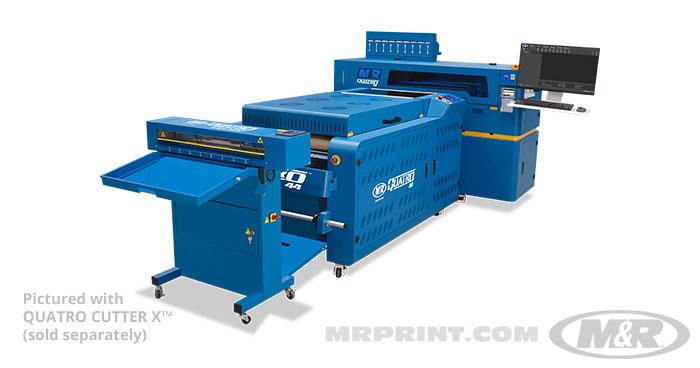
At M&R, we’ve focused heavily on building ink that runs clean and consistently on the Quatro platform. The goal is not just print quality, it is uptime.
DTF Powder: Where Durability and Feel Come Together
DTF powder is one of the most overlooked parts of the process, but it plays a major role in the final product. This is what controls adhesion to the garment, stretch and durability, hand feel and wash performance.
What to look for:
- Even and consistent cure
- Strong adhesion without creating a heavy feel
- Flexibility after curing
- Consistent particle size
A poor powder leads to cracking, stiff prints, and unhappy customers. A good powder blends into the process and just works. The key is balance. Strong adhesion is important, but not at the expense of feel.
The best results usually come from systems that are developed together, not pieced together. M&R takes that approach by developing their DTF powder alongside their ink and film, which helps maintain consistency across real production.
DTF Film: The Transfer Medium That Can Make or Break You
If something is wrong with your DTF film, you will know immediately.
Common issues shops run into with lower quality film include:
- Ink not releasing cleanly
- Inconsistent coating
- Static affecting powder application
- Feeding issues in the printer
This can cause all types of headaches and down time for shops. Going the extra mile and doing your own research and spending a little extra cash on film can make all the difference.
What we look for:
- Clean and consistent release
- Uniform coating across the roll
- Smooth feeding through your DTF printer
- Compatibility with our ink system
Film is where a lot of shops try to save money. It usually backfires. Even the best DTF printer and the best DTF ink cannot fix poor film. If the transfer fails, the print fails.
The DTF Transfer System Mindset
This is where most shops either level up or stay stuck. You can run a direct to film printer with mixed components from different suppliers. Sometimes it works. More often, it creates constant adjustments and inconsistency. DTF is not forgiving when things do not match. The shops that succeed treat their setup as a complete DTF transfer system, not a collection of parts.
One thing that separates more advanced operations from everyone else is the level of testing behind the system. At M&R, we’ve invested in a dedicated consumables lab where DTF ink, film, and powder are continuously tested together on the Quatro platform. The goal is simple, make sure the full system performs consistently under real shop conditions.
Cost: Where Most Shops Get It Wrong
When comparing supplies for a DTF printing machine, most people look at cost per unit. That is not the right way to think about it. The top print shops we work with focus on these factors:
- Print success rate
- Reprints
- Machine uptime
- Labor spent fixing issues
- Final product quality
There is also a simple truth in DTF. You get what you pay for with consumables.
If you are running cheap DTF ink, DTF powder, or DTF film through your DTF printer, you are increasing the chances of clogging, failed transfers, and inconsistent results. That leads to additional cost, wasted material, downtime, and frustration.
Lower cost supplies often end up being more expensive once you factor in lost production. The most successful shops focus on consistency, not just price.
Handfeel: Changing the Perception of DTF
One of the biggest knocks on DTF has been handfeel. And it is true. With the wrong setup, prints can feel heavy. But with the right DTF transfer system, it is a completely different result.
These are the things we do to improve handfeel:
- Proper art set-up
- Appropriate ink laydown
- Balanced powder application
- Clean film release
- Correct curing
When everything is dialed in, the print feels softer and more flexible than most people expect from DTF. This is another area where a system approach matters. When ink, powder, and film are developed to work together, you see a noticeable difference in both durability and feel.
Final Thought: Build for Production
A lot of DTF printers look great in demos. Real shops are different. Long runs, multiple operators, tight deadlines. That is where the difference shows up. If you are investing in a direct to film printer, the goal is not just to create a great print once. It is to create great prints consistently, every day. That is where a complete system, like the M&R Quatro DTF printer paired with a well-matched set of ink, powder, and film, starts to separate itself.
Bottom Line
DTF success does not come from one component. It comes from how everything works together:
- DTF printer and dryer
- DTF ink
- DTF powder
- DTF film
When those pieces are aligned, production becomes predictable. And when production is predictable, profitability follows.